
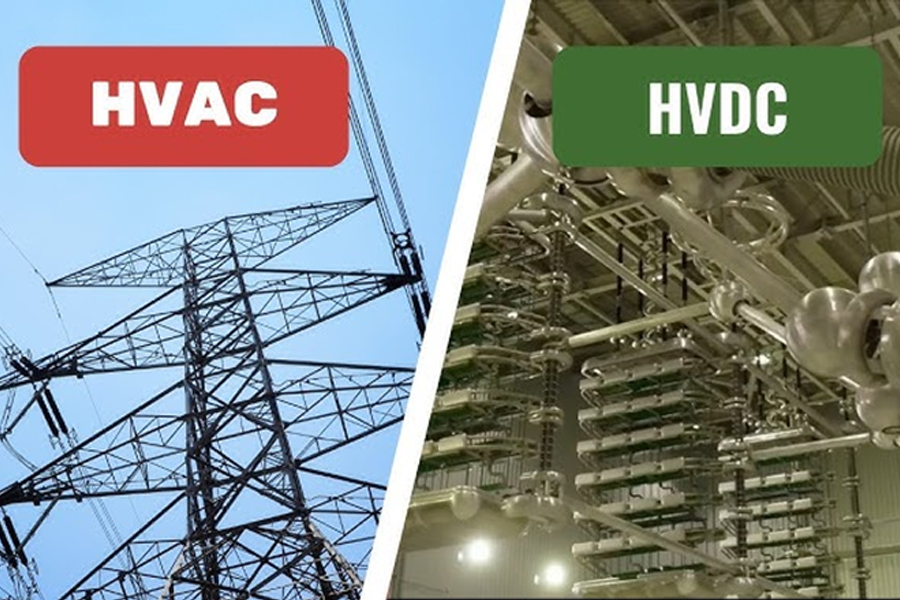
India’s power network is the backbone of its growing economy, spanning vast distances from remote generation sites to densely populated consumption centers. A key question in power transmission is whether to use traditional high-voltage alternating current (HVAC) lines or high-voltage direct current (HVDC) systems. Both technologies play crucial roles, but they have distinct characteristics, advantages, and drawbacks. This article provides an in-depth look at HVAC vs. HVDC transmission, explains how each system works, and examines their real-world applications – with a special focus on why certain transmission projects in India use one over the other. We’ll also highlight notable Indian projects and the reasoning behind the government’s technology choices, all in an informative yet approachable way for industry professionals, policy makers, and curious readers alike.
Understanding HVAC and HVDC Transmission
High-Voltage AC (HVAC) Transmission: Most of the world’s electric grid, including India’s, operates on alternating current. AC means the flow of electricity reverses direction periodically (50 times per second in India’s 50 Hz grid). Using transformers, AC voltage can be stepped up to very high levels for long-distance transmission and then stepped down for distribution to consumers. AC transmission has been the standard for over a century because early on it was easier and cheaper to implement at high voltages. India’s national grid is a large synchronous AC network – one of the world’s largest – operating at a single frequency of 50 Hz. The highest standard AC transmission voltage in India is 765 kV (with one pilot line built for 1200 kV), reflecting how AC technology has been pushed to transmit more power over longer distances.
High-Voltage DC (HVDC) Transmission: In an HVDC system, electricity flows as direct current – a constant, one-directional flow. Advancements in power electronics (like thyristors and IGBT converters) now allow efficient conversion between AC and DC at scale. An HVDC link typically requires a converter station at each end to convert AC to DC and then back to AC. Because DC doesn’t oscillate, it avoids many limitations of AC. HVDC can transmit power between unsynchronized grids (even at different frequencies) and over extremely long distances with lower losses. In India, HVDC has evolved from a niche solution in the 1980s to a key component of national transmission planning, complementing the AC grid for difficult or high-capacity routes.
Key Differences Between AC and DC Transmission
At a high level, HVAC and HVDC both aim to move electricity at high voltages to reduce losses, but they behave very differently:
- Current Flow and Frequency: AC is an oscillating current that alternates direction 50 (or 60) times per second, whereas DC flows continuously in one direction. This means HVDC links have no frequency, allowing them to connect two AC systems without synchronizing them. By contrast, an AC line directly connects only to grids operating at the same frequency.
- Number of Conductors: A typical HVAC transmission line is three-phase, requiring three (or multiples of three) wires for carrying current. HVDC, in contrast, uses only two conductors (positive and negative poles) or even a single pole with ground return in some cases. Fewer conductors and no need for phase synchronization can simplify the line design and reduce the corridor width needed for the same power capacity.
- Reactive Power and Losses: AC transmission inherently produces and consumes reactive power – a byproduct of the alternating electric and magnetic fields. Reactive power doesn’t do useful work at the load, but it causes voltage drop and energy losses over distance. The oscillating voltage also leads to capacitance effects with the ground, causing additional losses (especially in long AC cables). HVDC has a big advantage here: a DC line has no reactive power or capacitive charging issues, so it suffers lower line losses over long distances. There’s also no “skin effect” in DC (where AC tends to flow near the surface of conductors, effectively reducing usable cross-section) and DC’s corona discharge losses are lower. These factors allow a DC line to carry more power with less loss over great distances compared to an AC line of equal voltage.
- Control and Stability: Power flow on an AC network is less controllable – it is determined by line impedance and the phase differences between interconnected generators. In contrast, an HVDC link uses electronic converters that tightly control the current and power flow. This controllability means HVDC can actively stabilize a grid by modulating power quickly, or prevent faults in one region from propagating to another (since the AC systems at each end are isolated by the DC link).
- Conversion Equipment: A major difference is the terminal equipment. HVAC requires transformers and switchgear, which are comparatively simple and have matured over a century. HVDC needs converter stations at the endpoints, packed with high-power electronics (valves, converters, filters, etc.). These stations are large, complex, and expensive – contributing to a significantly higher upfront cost for HVDC projects versus AC for the same distance.
Advantages of HVAC Transmission
Despite the recent buzz around HVDC, traditional HVAC lines have several enduring strengths:
- Cost-Effective for Short Distances: For relatively short distances and moderate power levels, AC is generally more economical.
- Flexible Network Integration: HVAC lines can be tapped at multiple points – power can be inserted or withdrawn by simply connecting a transformer.
- Mature Technology: Equipment and operations are well-understood, with a large ecosystem of suppliers and expertise.
- Redundancy and Reliability: AC grids often have multiple pathways for power to flow, providing redundancy in case of faults.
Disadvantages of HVAC Transmission
- Higher Losses Over Long Distances: Capacitive charging, inductive reactance, and other effects reduce efficiency.
- Need for Reactive Power Compensation: Long AC lines need equipment like reactors and capacitors.
- Larger Transmission Corridor: More conductors and wider spacing increase the land required.
- Limited Long-Distance Cable Use: AC cables are not efficient for very long distances due to capacitive charging.
Advantages of HVDC Transmission
- Lower Losses Over Long Distances: HVDC is more efficient beyond a certain distance threshold (~600–800 km overhead).
- Compact Footprint: Narrower corridors and fewer conductors reduce land acquisition needs.
- High Capacity: HVDC lines can transmit several gigawatts on a single corridor.
- Asynchronous Connectivity: Enables connections between separate grids.
Power Flow Control: Improves grid stability and allows fast response to changing conditions.
Disadvantages of HVDC Transmission
- High Converter Costs: Converter stations are expensive, making HVDC less viable for short distances.
- Complexity: Requires specialized expertise to design, operate, and maintain.
- Less Flexible: Tapping power along the route is difficult and costly.
- System Integration: Loss of an HVDC line removes a large chunk of power with no automatic rerouting as in AC grids.
When to Use HVDC vs. HVAC: Key Considerations
- Distance: HVDC is favored for long-haul transmission (typically >600 km overhead).
- Power Level: HVDC suits very high capacity transfers (>2,000 MW).
- Grid Structure: HVAC for interconnected networks, HVDC for point-to-point.
- Land Availability: HVDC requires a smaller right-of-way.
- Grid Synchronization Needs: HVDC links can connect grids with different operating frequencies.
Indian Context: Notable Projects
HVAC Projects:
- Wardha–Aurangabad 1200 kV AC Pilot (700 km): Developed to test ultra-high voltage AC technology. Allows tapping at multiple points for regional power distribution.
- 765 kV AC Backbone: Widely used across India for inter-state transmission. Offers a cost-effective, high-capacity AC solution for large-scale grid integration.
HVDC Projects:
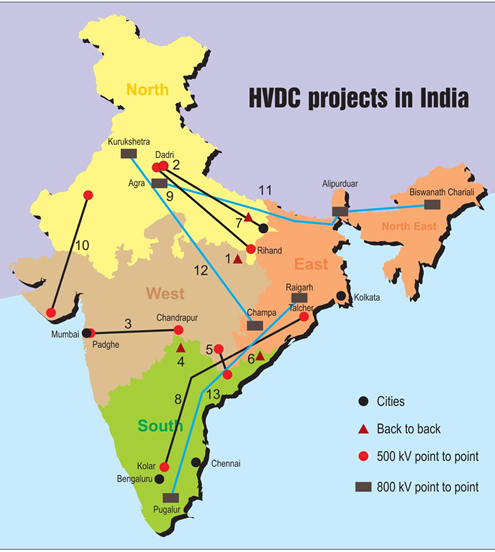
- Raigarh–Pugalur ±800 kV Link (1830 km): Connects Chhattisgarh to Tamil Nadu with 6,000 MW capacity. Enables north-south power flow and renewable integration with land and loss savings.
- North-East Agra ±800 kV Multi-Terminal Link (1728 km): Transmits hydropower from the Northeast to the north. Multi-terminal configuration pools power from multiple stations into Agra with reduced losses.
Conclusion
Both HVAC and HVDC transmission systems are indispensable in powering India’s vast electrical grid. HVAC lines form the widespread network that lights our cities and villages, offering flexibility to tap and distribute power along the way. HVDC links, meanwhile, serve as the express highways of the grid – hauling huge amounts of electricity across great distances, bridging regions, and reinforcing stability in ways HVAC cannot.
In India’s context, the mix of HVAC and HVDC has been carefully calibrated to the country’s needs. HVAC technology continues to be the workhorse for the majority of transmission needs, while HVDC is deployed strategically for long-distance and high-capacity corridors.
The government’s strategy reflects a pragmatic understanding: use HVAC for the mesh and HVDC for the long haul. Notable projects like the North-East Agra UHVDC or Raigarh–Pugalur UHVDC show how cutting-edge HVDC is expanding the grid’s reach and reliability, enabling India to deliver power where it’s needed with minimal losses and environmental impact.
Sources:
- Power Grid Corporation of India (PGCIL)
- Ministry of Power
- Power Line Magazine
- Hitachi Energy India
- BHEL Press Releases
- The Earth and I Energy Reports
- Wikipedia: List of HVDC Projects
- CEA and Government Reports on Transmission Planning.