In an era defined by rapid renewable energy growth and ambitious decarbonization targets, ensuring grid reliability and worker safety** is paramount. High Voltage Testing Instruments (HVTI) is at the forefront of delivering cutting-edge safety equipment and condition-monitoring systems that empower utilities, grid operators, and industrial facilities to integrate renewables seamlessly while protecting personnel and assets.
The Renewable Transformation and Its Challenges
India’s installed power capacity reached 466 GW in January 2025, with renewables (solar, wind, small hydro, bio) accounting for over 40% of generation capacity. Solar alone grew to 100 GW, up from 66 GW in 2023; wind stands at 48 GW, and small hydro and bio collectively add another 16 GW. Yet coal remains critical at 220 GW (47% of capacity) as grids balance intermittency and demand peaks.
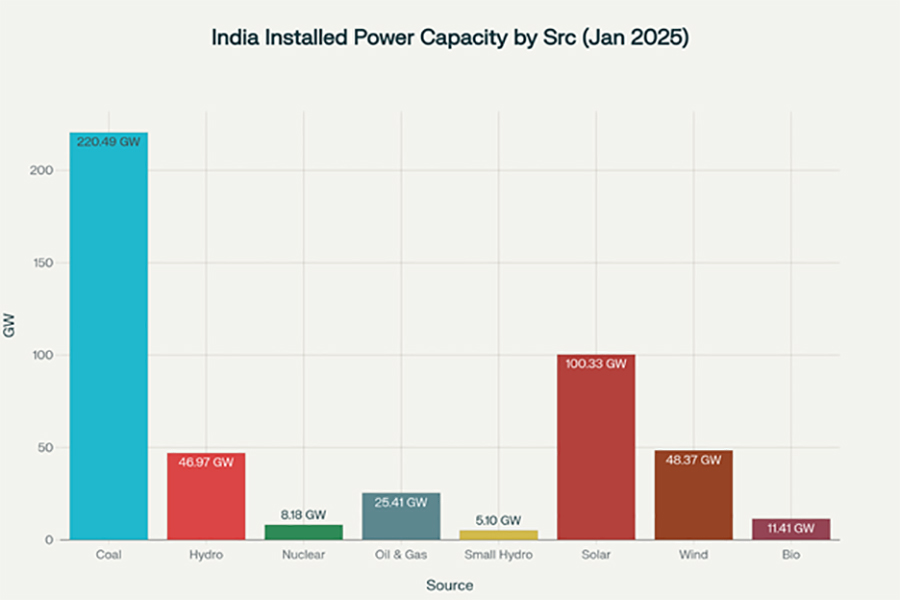
Bar chart of India’s installed power capacity by source as of January 2025
While this energy mix shift accelerates decarbonization, it introduces:
- Intermittency Risks: Rapid output fluctuations from PV and wind challenge voltage stability and require robust real-time monitoring.
- Complex Safety Environments: Live-line work on evolving grid assets demands precise detection tools to prevent arc flashes and ensure personnel protection.
- Aging Infrastructure: Legacy substations and transformers require continuous condition monitoring to avert unplanned outages in a renewable-rich network.
Ultra-Mega Solar Parks: Pillars of Scale
Project | State | Capacity (MW) | Commissioned | Key Features |
Bhadla Solar Park | Rajasthan | 2245 | Dec 2018 | World’s largest PV park; four phases; 14 000 acres; 10 million panels; →4 mt CO₂ saved/yr |
Pavagada “Shakti Sthala” | Karnataka | 2050 | Dec 2019 | 13 000 acres leased from 2 300 farmers; eight 250 MW blocks; 40 blocks total; offsets 3.6 mt CO₂/yr; drought-hit land repurposing |
Rewa Ultra Mega Solar | Madhya Pradesh | 750 | Jan 2020 | Broke grid-parity at ₹2.97/unit; first institutional off-taker (Delhi Metro 24%); 1 590 acres; World Bank-CTF support |
Kurnool Ultra Mega Solar Park | Andhra Pradesh | 1000 | Mar 2017 | 24 km²; 4 million panels; 8 GWh/day; ₹70 bn investment; four 220/33 kV pooling stations; meets district demand |
NP Kunta Ultra Mega Solar Park | Andhra Pradesh | 978.5 | 2019 | Spread over 32 km²; step toward 1 500 MW planned; Andhra plans to add 2 750 MW more |
Kadapa Ultra Mega Solar Park | Andhra Pradesh | 250 (pl.) | 2018 | Initial 250 MW; tendered to reach 1 000 MW; part of central NSM park scheme |
Kurnool (Greenko) 816 MW Phase | Andhra Pradesh | 816 | Mar 2017 | Delivered in 166 days; sourced modules from tier-1 suppliers; air-freighted inverters to accelerate timelines |
Charanka Solar Park | Gujarat | 615 | 2012 | India’s first solar park under NSM; pioneered tariff-based competitive bidding |
solar power has surged thirty-fold, underpinning India’s commitment to achieve 500 GW of non-fossil capacity by 2030. This transformation is driven by ultra-mega solar parks, corporate green-energy commitments, and supportive policies—but brings complexities in land use, grid integration, and stakeholder alignment.
Land, Finance, and Community Impacts
- Land Use & Farmers’ Livelihoods
Pavagada’s model leased 13 000 acres from farmers on 25-year contracts, providing steady income but prompting debates on agricultural displacement and food security. - Financing & Tariffs
Competitive reverse auctions drove solar tariffs from ~₹4.50/unit in 2017 to under ₹3.00/unit at Rewa, with World Bank/CTF loans shaving 4–5 paise/unit. - Grid Integration
Rapid capacity additions strain evacuation infrastructure. Parks include internal pooling stations and dedicated transmission lines to feed central substations, yet regional balancing remains challenging during peak generation.
Advanced High Voltage Detection: Safeguarding Live-Line Operations
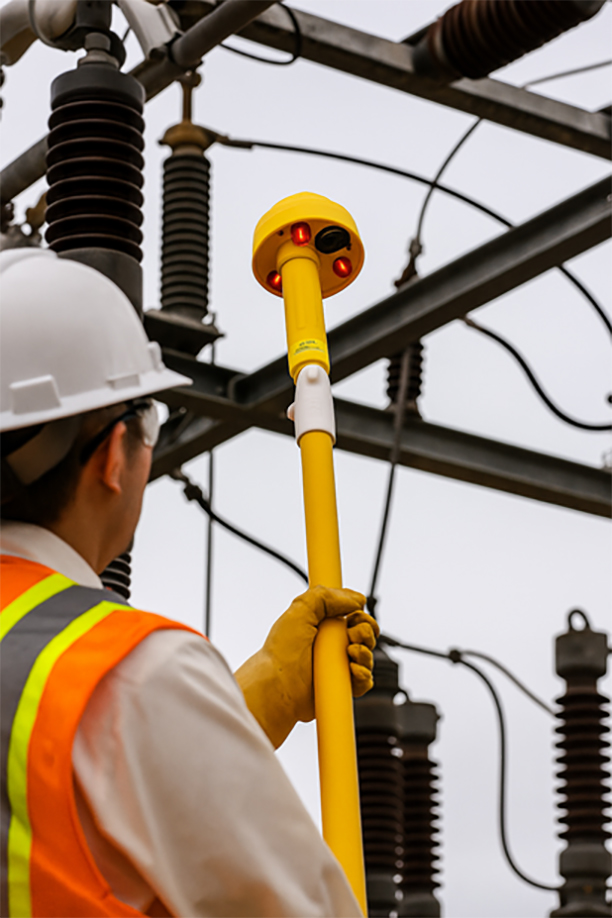
HVTI’s flagship TP-S9 Hand-Held High Voltage Detector addresses the critical need for accurate, non-contact live-line indication:
- Capacitive Sensor Technology delivers reliable detection from 240 V to 510 kV (extendable to 765 kV) with adjustable sensitivity.
- Bright Audible & Visual Alerts ensure clear indication in both daylight and noisy substation environments.
- Self-Test Mode verifies detector health before and after each use, aligning with IEC and IS safety standards.
- IP66 Rating and universal C-size battery power provide durability and long-lasting operation in harsh outdoor conditions.
By confirming whether conductors are live before maintenance, the TP-S9 reduces accident risk and supports compliance with stringent safety regulations.
Condition Monitoring: Enabling Predictive Maintenance in Renewable Grids
To integrate renewables at scale, grid operators are deploying Battery Energy Storage Systems (BESS) and smart sensors for real-time asset health insights. HVTI’s condition monitoring portfolio includes:
- Partial Discharge Monitoring Systems for early detection of insulation defects in transformers and switchgear.
- Portable Temperature & Vibration Monitors to track hotspot formation in wind turbine gearboxes and substation equipment.
- IoT-Enabled Data Loggers that feed cloud platforms, enabling analytics-driven maintenance scheduling and reducing unscheduled downtime.
These solutions support the shift toward predictive maintenance, ensuring that storage plants and renewable generation assets remain reliable under variable operating conditions.
Integrating Safety with Smart Grid Initiatives
With India targeting 500 GW of non-fossil capacity by 2030, smart grid deployments—including advanced metering infrastructure and grid-edge storage—are accelerating. HVTI’s instruments integrate seamlessly into these frameworks:
- Universal Connector Compatibility ensures that HV detectors and hot sticks interface with standard sunrise connectors used across utilities.
- Modular Extension Handles adapt TP-S9 detectors for varying voltage levels without additional tooling.
- Remote Monitoring Compatibility aligns with distributed energy resource management systems (DERMS), providing field data for centralized grid control rooms.
Driving a Safe, Sustainable Energy Transition
As renewables reshape India’s power landscape, safety and reliability are non-negotiable. HVTI’s suite of high-voltage detection and monitoring solutions empowers engineers, technicians, and operators to:
- Assure live/dead verification before any maintenance, preventing electrical accidents.
- Implement condition-based inspections that preempt equipment failures and optimize asset life.
- Integrate seamlessly with smart grid platforms, supporting real-time visibility and control.
By combining innovative technology, rigorous testing, and customer-centric design, HVTI is setting new benchmarks in electrical safety and condition monitoring—ensuring that India’s journey toward a renewable-powered future is both resilient and secure.
Join the conversation: How is your organization addressing safety and reliability challenges in renewable integration? Share your experiences and connect with us at HVTI to explore tailored solutions.