
Partial discharge (PD) is a localized breakdown of part of an electrical insulation system under high voltage stress – an electrical discharge that does not completely bridge. In practice, PD often initiates in microscopic voids, cracks or air bubbles within solid or liquid dielectrics (for example, resin, transformer oil, or epoxy. These tiny discharges are not visible to the naked eye, but cumulatively they erode insulation over time, eventually leading to full. Technically, PD includes phenomena like corona around sharp conductors, surface discharges on contaminated insulation, and internal (void) discharges within solid dielectrics. For instance, void (internal) discharges – caused by defects in solid insulation – “are highly destructive” and will expand until complete. (Other PD types include corona, arcing, and surface-tracking. In summary, PD is essentially a partial flashover within insulation that gradually weakens the system if not.
Common Causes of PD in HV Equipment
High-voltage equipment can host PD for several reasons. Some of the main causes include:
- Insulation Defects and Aging: Tiny voids, bubbles or inclusions in cables, bushings, or transformer winding insulation create high-field spots. These defects may originate from manufacturing or accumulate with age and thermal. Over time, the lower dielectric strength at a void concentrates stress and sparks partial discharges. For example, in cables the most common PD sites are at terminations and splices where such imperfections often.
Moisture and Contamination: Water ingress, oil contamination or surface dirt on insulators dramatically lower breakdown strength. Humidity and pollution on bushings or switchgear can trigger surface discharges or tracking. Indeed, studies point out that PD activity caused by humidity and dust “will only increase once it has started,” and water/dust ingress often leads to costly. In practice, contaminated overhead insulators or transformer bushings routinely suffer surface PD under Indian monsoon or dusty.
Electrical/Mechanical Stress: Over-voltages (lightning surges, switching spikes) and overloads stress insulation. Repeated stress and heating accelerate aging and can open tiny cracks. When insulation degrades under this stress, PD can initiate. In transformers, prolonged overloading causes oil deterioration and moisture formation, which ultimately create PD.
Installation Errors or Damage: Poor joints, loose terminations, or sharp edges introduce PD sources. Human factors play a role: PD “weak points tend to occur at human-made joints or terminations,” so finding PD allows preventive work on a joint otherwise destined to. In cable systems, improper installation at connectors often leads to interfacial.
Each of these issues – internal voids, surface contamination, overstress, or installation flaws – creates conditions where the electric field locally exceeds insulation strength. This causes repeated micro-discharges. As Fluke explains, such minor defects trigger “thousands of mini repetitive discharges,” which grow over time and can culminate in catastrophic.
Effects of Undetected PD
If PD goes undetected, the consequences range from immediate equipment impairment to long-term reliability loss. In the short term, PD can induce local heating, carbon tracking or pitting in the dielectric. This rapidly degrades the insulation material. The impact is often dramatic: Fluke notes that damaging PD leads directly to outages, fires, and equipment. For example, a PD-induced flashover in a transformer or switchgear cell can trip protection relays or even cause an internal arc. Utilities have observed that undetected PD is frequently the root cause behind sudden circuit failures. In practice, a single PD fault in a transformer winding or cable joint can knock that asset offline immediately, triggering unplanned shutdowns. As one industry report puts it, PD-related failures often result in significant downtime and safety.
In the long term, repeated PD pulses act like invisible erosion. Each discharge removes a bit of insulation integrity until dielectric breakdown is inevitable. Over years, this means the asset’s expected life is greatly shortened. Mechanical, thermal and chemical stress from PD events convert good insulation into a carbonized, cracked path. Critically, PD in early stages is largely silent – by the time an insulation fault becomes obvious, the damage is severe. One survey of high-voltage faults found that roughly 85% of disruptive substation failures involve PD-related insulation, underscoring how pervasive the risk is. Moreover, such failures are very costly: in high-voltage networks, a single substation outage can cost up to ~$650,000 per day. (In effect, every day a transformer or GIS is down for repair incurs huge lost load penalties.)
In summary, undiagnosed PD can cause immediate outages and damage, and over time it silently undermines equipment health. The result is higher maintenance needs, early asset retirement, and an increased risk of major blackouts.
PD Failures in Indian Power Systems
India’s power grid is no exception to these issues. National data indicate that insulation-related faults and bushing failures – classic PD symptoms – are among the most common causes of transformer outages. An executive summary by India’s Central Electricity Authority (CEA) reports that, of 21 transformer failures (2015–16), many occurred in relatively new machines. In other words, defects in the insulation system were flagged as culprits in a majority of failures. Similarly, industry sources note that roughly 41% of transformer failures in India were due to insulation. These statistics underscore PD’s role: bushings and coils often fail not from simple overload, but from progressive dielectric damage.
Environmental factors in India amplify the risk. High humidity, saline coastal air, and dust pollution create perfect conditions for PD on switchgear and overhead lines. As one technical note observes, “water and dust ingress in substations can lead to partial discharge and cause costly power outages. In practice, utilities routinely contend with PD-accelerated failures after monsoon seasons or in industrial areas. A single PD defect in an important transformer or cable can thus cascade into regional outages. Although comprehensive public case studies are scarce, these industry reports and analyses make clear that PD-induced insulation failure is a major reliability issue for Indian utilities.
Quantified Impacts: Downtime, Maintenance, and Costs
The stakes of PD become clear when quantified. Unplanned outages and emergency repairs are extremely expensive compared to preventive care. For example, one maintenance survey notes that unplanned electrical failures can cost roughly 10× more than planned. In practical terms, routine PD testing and upkeep might be measured in tens or hundreds of thousands of dollars annually, whereas a single transformer replacement or multi-day outage can reach millions. The disparity is illustrated below:
Figure 1 (below) illustrates the cost impact of maintenance strategy: proactive (planned) maintenance costs a fraction of the bill for an unplanned

Key Insight: Early PD detection
The Value of Online PD Monitoring
Given the severe consequences, detecting PD early is critical. Traditional PD tests (insulation resistance, VLF tests, etc.) are done offline during scheduled outages, but PD can develop in between tests. By contrast, on-line PD monitoring lets utilities catch issues before failure. Continuous sensors (acoustic, ultra-high-frequency, or partial discharge couplers) watch the equipment in real time. This approach has several advantages:
Real-Time, Continuous Monitoring: On-line systems run during normal operation (no shutdown needed), detecting PD activity as it happens. This avoids the “caught too late” problem of periodic tests. As one review notes, only on-line monitoring avoids costly shutdowns and provides early warning of defects.
Condition-Based Maintenance: With instant feedback, maintenance becomes proactive. Utilities can repair or replace at-risk insulation before breakdown. This shifts maintenance from fixed schedules to condition-based programs, dramatically reducing emergency repairs. Electrical India reports that online monitoring “reduces cost related to operation and maintenance” by enabling a move from time-based to condition-based diagnostics.
Integrated Alerts and Controls: Modern PD monitors interface with control systems. They generate real-time alarms and can even send remote alerts. For example, systems today can trigger SCADA alarms and GSM text messages when PD thresholds are crossed. This allows operators or asset managers to respond immediately to rising PD levels.
Combined Sensing: Many solutions pair PD measurement with temperature sensors. Hotspots on bushings or connectors often coincide with PD activity. An integrated system can monitor both electrical (PD) and thermal data for a fuller picture of health.
In essence, on-line PD monitoring makes electrical assets “self-reporting”. Instead of waiting for a fault, engineers get actionable data and can schedule fixes long before a catastrophic outage. Studies suggest that because a large majority of HV faults are PD-related, almost all unplanned outages are avoidable if PD is caught in time.
HVTI’s Online PD Monitoring Solution
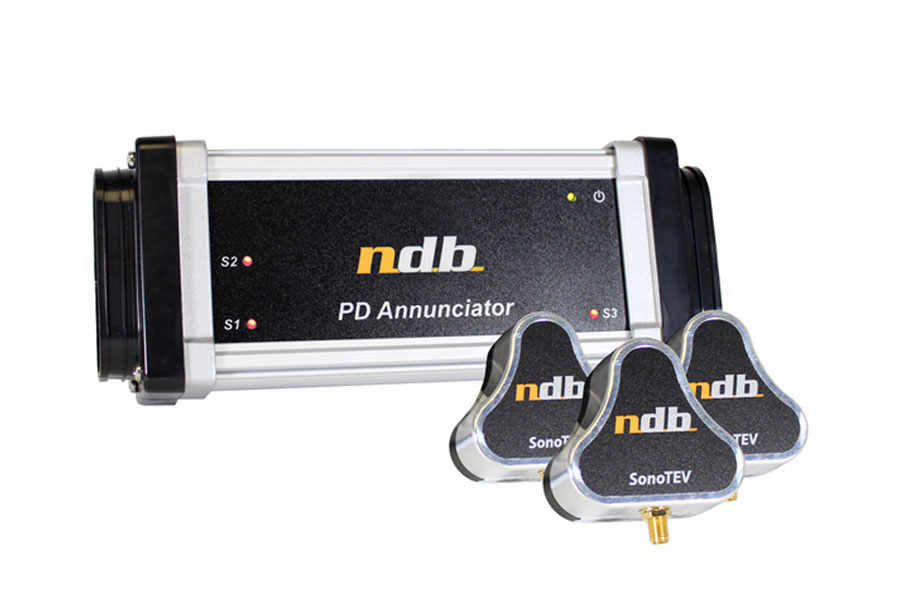
Our online PD monitoring system (the “PD Annunciator”) exemplifies this proactive approach. Key features include:
Continuous Tracking: The PD Annunciator continuously measures discharge activity on switchgear, RMUs, or dry transformers. If any PD is detected, it immediately alerts through the Local Scada or monitoring system with the ability to give GSM alerts as well.
SCADA and GSM Alarms: The device seamlessly integrates with utility SCADA networks. On PD detection, it transmits alarms to the control room and can send GSM text-message alerts to mobile. This ensures rapid awareness of insulation issues even if personnel are off-site.
Modular & Scalable: Each module supports up to three PD sensors (and can be daisy-chained to monitor many assets). Installation is quick – units snap onto a DIN rail or magnetically to panels without rewiring. Over 5000 HVTI PD sensors are already deployed worldwide.
Integrated Temperature Sensors: HVTI offers wireless passive temperature probes that connect to the same system. These sensors monitor busbars, connectors, or cable joints for overheating. Combined with PD data, this lets engineers correlate rising temperature with electrical stress.

By delivering real-time PD and temperature data straight into asset-management systems, HVTI’s solution enables predictive maintenance. An engineer can trend partial-discharge levels on each transformer or switchboard in service. If PD starts climbing, a maintenance work order can be issued well ahead of any failure. In effect, utilities gain the ability to “see inside” the insulation continuously.
prevents failure, saving ~90% of costs and minimizing grid downtime.
These features mean fewer unplanned shutdowns and longer equipment life. With our on-line PD Annunciator (and optional temperature sensing), high-voltage utilities in India can monitor insulation health continuously, respond instantly to warnings, and avoid the cascading failures that PW (power utility) grids dread.
Read more about our system here: https://hvti.in/partial-discharge-pd-monitoring/
Contact Details+91-9990246301 ; contact@hvti.in